

smart history
Origin
smart was born in the 1990s from a collaboration between Swatch, the Swiss watch company, and Mercedes-Benz. The original idea of a tiny, two-seat city car became the smart fortwo, launched in 1998 and built in Hambach, France. Over two decades smart remained a Mercedes-Benz brand focused on urban mobility, adding the four-seat forfour and, from 2007, electric versions. By 2019 smart had become an all-electric brand in Europe, but the tiny cars were costly to build and rarely profitable.
Ownership
In 2019 Daimler (now Mercedes-Benz Group) and Geely Holding agreed to turn smart into a 50:50 joint venture, smart Automobile Co., based in Ningbo, Zhejiang. The joint venture started operating in 2020. Mercedes-Benz is responsible for design, while Geely handles engineering and production. New smart models are built at Geely's plant in Xi'an and exported worldwide. smart Automobile has its own sales companies in China and Europe.
Key milestones
- 1998: the first smart fortwo goes on sale in Europe.
- 2007: the first electric smart is introduced.
- 2020: the smart Automobile joint venture of Geely and Mercedes-Benz begins operations.
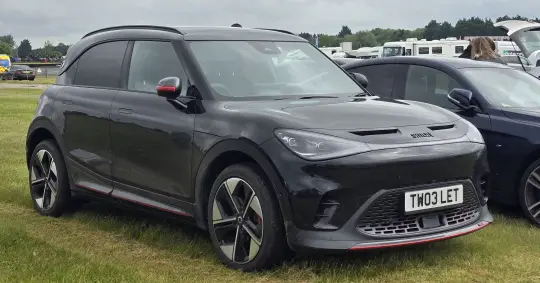
- 2022: the smart #1 electric SUV goes on sale in China and Europe.
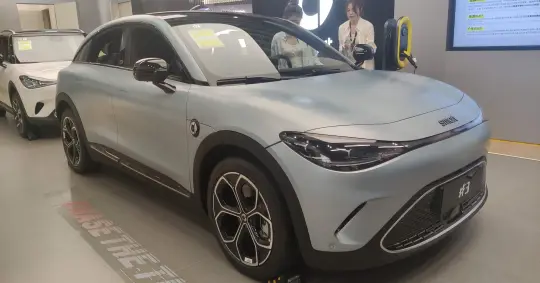
- 2023: the smart #3, a coupe-styled electric SUV, is launched.
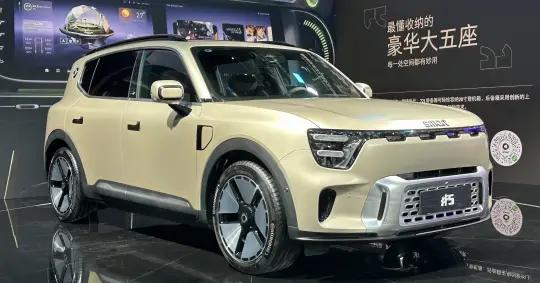
- 2024: the larger smart #5 SUV is revealed and launched, with an 800-volt version and long-range batteries.
- 2025–2026: smart prepares a new small car, the #2, as a successor to the fortwo.
Products and technology
All new smart cars use Geely's SEA (Sustainable Experience Architecture) electric platform. The #1 is a compact five-door SUV with rear-wheel or all-wheel drive; the #3 is a slightly longer coupe-SUV with a sloping roof; the #5 is a mid-size SUV with more space, longer range and fast charging. The high-performance BRABUS versions use two motors with more than 400 horsepower. Inside, smart cars feature large screens, playful graphics and connected services developed with Chinese tech partners. Their styling, by Mercedes-Benz designers, uses frameless doors, pop-out handles and a rounded, friendly look.
Chinese name and positioning
In China the brand is called smart Jingling, meaning "elf", and models are named smart Jingling #1, #3 and #5. smart positions itself as a premium, design-focused brand for young urban buyers, with prices above mainstream Chinese brands but below Mercedes-Benz.
smart today
smart has changed from a maker of tiny two-seaters into a brand of stylish electric SUVs. It sells in China, across Europe, in Australia, New Zealand, South-East Asia and the Middle East, making it one of the most international products of the Geely group.
Design and technology
The new smart models combine Mercedes-Benz design with Geely engineering. They are built on Geely's SEA architecture, with rear- or all-wheel drive, 800-volt technology in the #5 and fast charging. The #1 is a compact SUV, the #3 a coupe-SUV with a sporty profile and the #5 a larger SUV with a more rugged look. All are fully electric and sold in China, Europe, Australia and other markets.
Market position
smart has repositioned itself from a city-car brand to a premium compact electric brand, competing with models such as the Volvo EX30, Zeekr X and Tesla Model Y. The joint venture gives Mercedes-Benz a presence in the compact electric segment while Geely contributes development and production.
Current line-up in China
Key figures for the current model year, taken from manufacturer specification data (Autohome configuration sheets). Prices are Chinese retail prices (MSRP) converted at 1 USD = 6.7075 CNY (PBOC central parity, 27 November 2026).
- smart #1 – small SUV; battery electric; 4,270 mm long with a 2,750 mm wheelbase; up to 245 kW; 0–100 km/h in 6.7 s; CLTC range 535 km; 5 seats; priced at CN¥152,900–172,900 (about US$22,795–25,777); battery 61.52 kWh; RWD; top speed up to 200 km/h; kerb weight 1,800 kg; driver assistance: God's Eye (Qianli Haohan) H5 with lidar.
- smart #3 – compact SUV; battery electric; 4,400 mm long with a 2,785 mm wheelbase; up to 315 kW; 0–100 km/h in 4.3 s; CLTC range 520 km; 5 seats; priced at CN¥209,900 (about US$31,293); battery 66 kWh; AWD; top speed up to 180 km/h; kerb weight 1,870 kg.
- smart #5 – mid-size SUV; battery electric; 4,705 mm long with a 2,900 mm wheelbase; up to 475 kW; 0–100 km/h in 3.8 s; CLTC range 660 km; 5 seats; priced at CN¥379,900 (about US$56,638); battery 100 kWh; AWD; top speed up to 210 km/h; kerb weight 2,400 kg; driver assistance: smart Pilot Assist with lidar.
Official website: smart.cn