

Lotus history
Origin
Lotus was founded in 1948 by the engineer Colin Chapman in north London. Chapman's philosophy of "simplify, then add lightness" produced light, agile sports cars such as the Seven, Elan, Esprit and Elise, and Lotus became one of the most successful teams in Formula One, winning seven constructors' titles between 1963 and 1978. The company moved to Hethel in Norfolk in 1966, where its sports cars are still built. After Chapman's death in 1982, Lotus passed through several owners, including General Motors, Bugatti's Romano Artioli and Malaysia's Proton.
Ownership
In 2017 Geely Holding bought 51 per cent of Lotus from DRB-Hicom, Proton's owner, which kept the rest. Under Geely the company was split into two parts. Lotus Cars in the UK builds the sports cars, while Lotus Technology, headquartered in Wuhan, develops and manufactures the new electric and hybrid lifestyle models. Lotus Technology listed on the Nasdaq in 2024, with Geely as its largest shareholder.
Key milestones
- 1948: Colin Chapman builds the first Lotus.
- 1957: the Lotus Seven, later built by Caterham, is launched.
- 1996: the Elise, a lightweight aluminium-chassis sports car, is introduced.
- 2017: Geely buys a majority stake.
- 2019: the Evija electric hypercar is revealed.
- 2021: the Emira, the last petrol Lotus sports car, is presented.
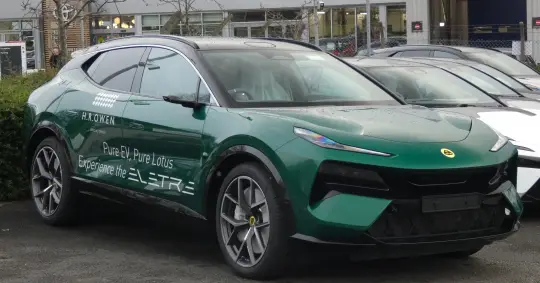
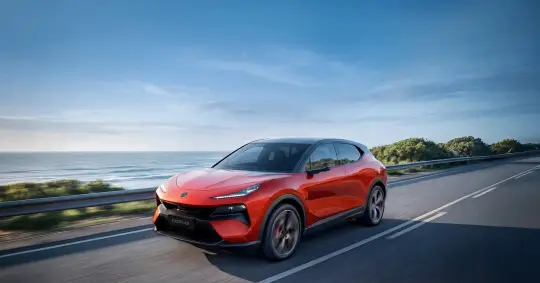
- 2022: the Eletre, an electric SUV built in Wuhan, makes its debut.
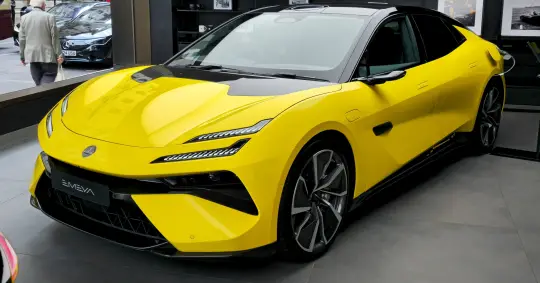
- 2023: the Emeya electric grand tourer is revealed.
- 2024: Lotus Technology begins trading on the Nasdaq.
- 2026: the For Me plug-in hybrid SUV, with Lotus's X-Hybrid system, is launched in China.
China-built models
The Eletre is a large electric SUV with up to about 900 horsepower in its most powerful version, 800-volt charging and lidar-based driver assistance. The Emeya is a four-door electric grand tourer on the same architecture. The For Me is a plug-in hybrid SUV with a 2.0-litre turbo engine, two electric motors, a 70 kWh battery and 420 km of CLTC electric range. These models are produced in Lotus Technology's Wuhan factory and exported to Europe, the Middle East and other markets. This catalog lists these China-built models; the UK-built Emira and Evija are sold in China as imports.
Lotus today
Lotus is transforming from a small British sports-car specialist into a global luxury performance brand. Its Chinese operations bring electric technology, scale and access to the world's largest car market, while Hethel continues to build the sports cars that made the name famous.
Engineering in China and the UK
The new generation of Lotus electric cars is engineered by teams in the UK, Germany and China and built in Wuhan on the Lotus Premium Architecture, a high-voltage 800-volt platform developed with Geely. The Eletre SUV and Emeya grand tourer offer up to around 675 kW in their most powerful versions, very fast charging and advanced driver assistance with lidar. The For Me, launched in 2026, is a large plug-in hybrid SUV that pairs a 2.0-litre turbo engine with two electric motors for up to 700 kW, a 900-volt platform and a CATL battery. Sports cars such as the Emira continue to be built in Hethel, England, and are not part of this catalog.
Market position
Lotus Technology competes with Porsche, BMW, Mercedes-AMG and premium Chinese brands. Sales have been lower than planned, and the company has adapted its plans with hybrid versions and a stronger focus on China and the Middle East.
Current line-up in China
Key figures for the current model year, taken from manufacturer specification data (Autohome configuration sheets). Prices are Chinese retail prices (MSRP) converted at 1 USD = 6.7075 CNY (PBOC central parity, 27 November 2026).
- Lotus Eletre – large SUV; battery electric; 5,103 mm long with a 3,019 mm wheelbase; up to 675 kW; 0–100 km/h in 2.95 s; CLTC range 535–680 km; 4–5 seats; priced at CN¥648,000–953,000 (about US$96,608–142,080); battery 112 kWh; AWD; top speed up to 265 km/h; kerb weight 2,600–2,670 kg.
- Lotus Emeya – full-size sedan; battery electric; 5,139 mm long with a 3,069 mm wheelbase; up to 675 kW; 0–100 km/h in 2.78 s; CLTC range 530–585 km; 4–5 seats; priced at CN¥558,000–963,000 (about US$83,190–143,571); battery 102 kWh; AWD; top speed up to 256 km/h; kerb weight 2,455–2,590 kg.
- Lotus For Me – large SUV; plug-in hybrid; 5,103 mm long with a 3,019 mm wheelbase; up to 700 kW; 0–100 km/h in 3.3 s; electric-only CLTC range 420 km; combined range up to 1,416 km; 5 seats; priced at CN¥508,000–668,000 (about US$75,736–99,590); battery 70 kWh; AWD; top speed up to 230 km/h; kerb weight 2,625 kg.
Official website: lotuscars.com.cn