



Dongfeng history
Origin
Dongfeng began in 1969 as the Second Automobile Works (Di'er Qiche Zhizaochang, usually called "Erqi"), a state project to build a second large truck plant alongside FAW in Changchun. It was located in Shiyan, a remote mountain town in north-western Hubei chosen for strategic reasons during the Cold War. The first product, the EQ240 2.5-tonne military truck, entered production in the mid-1970s, and the civilian EQ140 five-tonne truck followed in 1978. The trucks carried the name Dongfeng, "East Wind", which became the company name in 1992, when the Second Automobile Works was renamed Dongfeng Motor Corporation. In 2003 the headquarters moved from Shiyan to Wuhan, the provincial capital.
Ownership and structure
Dongfeng Motor Corporation is owned by the Chinese central government through SASAC and is one of the country's four largest car groups, together with FAW, SAIC and Changan. Its listed arm, Dongfeng Motor Group, was quoted in Hong Kong from 2005; in 2025 the group announced a plan to take it private while listing the Voyah premium electric brand separately. The structure combines three layers: joint ventures with foreign carmakers, Dongfeng's own passenger-car brands, and a large commercial-vehicle business that includes Dongfeng trucks and buses.
Joint ventures
For most of its history Dongfeng's passenger cars came from joint ventures. Dongfeng Peugeot-Citroën (Shenlong) was founded in 1992, followed by Dongfeng Yueda Kia, Dongfeng Nissan and Dongfeng Honda in the early 2000s. Dongfeng Nissan became one of China's biggest car companies with models such as the Sylphy, while Dongfeng Honda built the CR-V and Civic in Wuhan. In 2014 Dongfeng also bought a stake in PSA Peugeot Citroën as part of a rescue of the French group, and it later became a shareholder in Stellantis. As Chinese buyers moved to local new-energy brands, several of these ventures shrank, and Dongfeng has shifted its focus to its own brands.
Own brands
- Aeolus (Fengshen, 2009) – mainstream sedans and SUVs, now including plug-in hybrids and electric cars.
- Forthing (Fengxing) – SUVs, MPVs and the Xinghai new-energy range, built by Dongfeng Liuzhou Motor.
- Voyah (2018) – premium electric and extended-range cars.
- M-Hero (Mengshi) – high-end off-road SUVs that grew out of Dongfeng's military vehicles.
- eπ (Yipai, 2023) – new-energy sedans and SUVs aimed at technology-minded buyers.
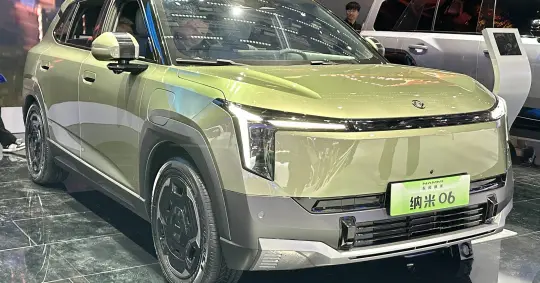
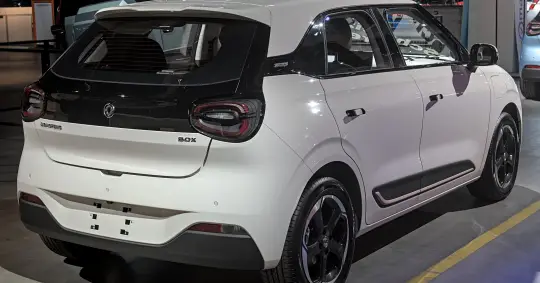
- Nammi (2023) – small, affordable electric cars such as the Nammi 01 (sold abroad as the Box) and Nammi 06.
Dongfeng also co-owns Dongfeng Sokon (DFSK) with Seres, the company behind Huawei's AITO cars.
Technology
Dongfeng's own technology is grouped under the "Mach" name. Mach Power covers its engines and hybrid systems, including the Mach DH-i power-split hybrid introduced on the Aeolus Haohan, and Mach E electric drive systems. The Quantum architecture provides scalable platforms for electric, plug-in hybrid and extended-range cars, used by Aeolus, eπ and Nammi models, while Voyah uses its own ESSA platform. Dongfeng develops batteries with partners such as CATL and has its own battery and motor plants in Hubei. In driver assistance and smart cockpits it works closely with Huawei: Voyah, M-Hero and eπ models use Huawei HarmonyOS cockpits and Qiankun driver assistance.
Markets
Dongfeng exports to more than 100 countries. Its strongest export regions are the Middle East, Central Asia, Russia, Latin America and Africa, and Voyah and Forthing have entered several European markets. The group also builds or assembles vehicles abroad with local partners. Within China, the move to new-energy vehicles is reshaping Dongfeng: its own electrified brands are growing while sales of joint-venture petrol cars decline.
This page lists Dongfeng-branded passenger cars such as the Nammi models; the other passenger brands of the group have their own pages, linked as sub-brands.
Current line-up in China
Key figures for the current model year, taken from manufacturer specification data (Autohome configuration sheets). Prices are Chinese retail prices (MSRP) converted at 1 USD = 6.7075 CNY (PBOC central parity, 27 November 2026).
- Dongfeng Nammi 01 – small hatchback; battery electric; 4,020 mm long with a 2,663 mm wheelbase; up to 70 kW; CLTC range 305–430 km; 5 seats; priced at CN¥59,800–92,800 (about US$8,915–13,835); battery 29.5–42.3 kWh; FWD; top speed up to 140 km/h; kerb weight 1,235–1,336 kg.
- Dongfeng Nammi 06 – small SUV; battery electric; 4,306 mm long with a 2,715 mm wheelbase; up to 135 kW; CLTC range 471 km; 5 seats; priced at CN¥99,900–109,900 (about US$14,894–16,385); battery 51.87 kWh; FWD; top speed up to 150 km/h; kerb weight 1,550–1,570 kg.
Official website: dongfeng-global.com